A Dream Realised: Eimy’s Boston Marathon Journey
Posted: 03 May 2026 21:34 | Read Time: 11 minutes
For many runners, the Boston Marathon is more than a race — it’s a lifelong ambition, a standard of excellence, and a symbol of everything that makes distance running special. For Gosforth Harrier Eimy, that dream became reality in 2026 after a journey defined by resilience, dedication, and extraordinary heart.
Completing the marathon in an incredible 3:18:54, we caught up with Eimy to find out how she went from dream to reality.
What did running the Boston Marathon mean to you personally?
It is a privilege to run it and to be there. As an amateur long-distance athlete it is the materialisation of a dream, to experience the marathon from the moment I got my qualifying time until the moment I crossed the finish line is something that will make me feel proud for the rest of my life.
How long had Boston been on your bucket list, and what made you finally go for it?
Boston has been on my bucket list since 2022, the year I started preparing for the Boston qualifying time. In 2023, I ran my first marathon in Medellin, Colombia (3:29), and although I achieved the BQ, I missed out in 2024 after the organisation published the cut-off. This motivated me even more and In May 2025, I achieved the BQ.
Can you talk us through the moment you qualified — did you know you had the time in you?
In 2024, I moved to the UK. It was a year of adjustment. I signed up for the Milton Keynes Marathon in September of that year and trained for eight months. That year, the Boston Marathon Organisation lowered the qualifying time by five minutes per age group, making it even more difficult.
In January 2025, I lost my mother and training became part of my therapy to cope with my grief. It was very special to finish that race after such an emotional year. My husband’s unconditional support has been fundamental in helping me achieve my goals and continue fulfilling my dreams. The target was 3:25, but I finished in 3:22, achieving the qualifying time for Boston 2026.
How did your training change once you knew you were heading to Boston?
My coach included more weight training sessions – three times a week – at least one hill repeat per week, and Wednesday track sessions – speed work – were also essential. But 80% of my marathon training was on a treadmill since it was during the winter. So I was very focused on having a good race and avoiding any injuries. I placed more emphasis on rest, quality sleep, and recovery after long days of work and training.
What was the toughest part of preparing for such an iconic race?
I would say the last month leading up to the race was intense. I work at a secondary school Monday through Friday, and aside from training, we have a life to live. There’s the responsibility at work, maintaining a decent social life, and family commitments that can’t be postponed. Maintaining balance in every aspect of life is the hardest part. I give credit to my husband; he helps and encourages me to pursue my dreams and achieve my goals. I’m not just an amateur runner who enjoys running and competing, I’m also a wife, a professional, a friend, a sister… Balancing everything is difficult and requires being surrounded by the right people.
Did you do anything different with your training for Boston that helped you get such an awesome result?
I prioritised my daily activities and recovery and rest time. I did most of my workouts on the treadmill, so to avoid boredom, I used to watch videos of the entire route on YouTube. I watched them so many times. I also increased the number of days I trained per week, dedicating 6 out of 7 days a week to training and resting on Sundays. Previously, I trained 3 or 4 days a week.
What was going through your mind on the start line in Hopkinton?
I was very connected to my surroundings, I was focused and smiling, the people were just as excited as I was, so I enjoyed everything that was happening. I felt very happy and grateful to be able to be on that starting line, I had nerves, adrenaline and excitement, a marathon ahead that I wanted to run.
Boston is famous for its atmosphere — what moment on the course hit you the hardest (in a good way)?
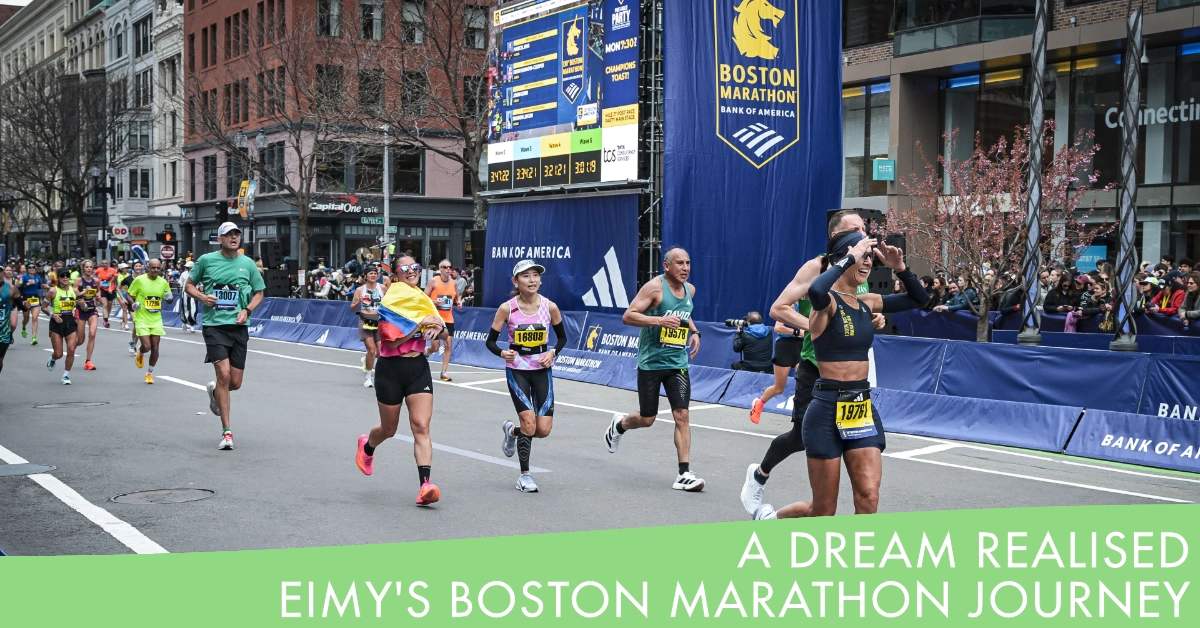
It was incredible to see so many people along the entire route. The last 3 miles were my favorite; I wore the Colombian flag draped over my shoulders, and the crowd was chanting my country’s name. Some people I knew were also near the finish line, and I heard my name called out amidst thousands of people—that was very special.
How did you handle the hills, especially Heartbreak Hill?
I trained for the climbs to be prepared, but they were tough. Especially with 20 miles of gentler climbs and long descents in my legs. During the three hills, there were lots of people around, a great atmosphere, and good music; the crowd helped me overcome each climb. I saw many people walking through Heartbreak Hill, but I felt strong. That gave me an extra boost and propelled me forward. I knew that after this climb, there were only the last 3 miles to finish the race.
Was there a point where you thought, “I’ve got this — today’s the day”?
At mile 21, when I passed Heartbreak Hill, I was ready to empty the tank and finish the race.
You came away with an incredible time — how did it feel crossing the finish line on Boylston Street?
I felt so excited and fulfilled, so proud. I found out my official time when I spoke with my husband just before receiving the medal. I burst into tears of emotion. I’m still processing it.
Did the race go to plan, or did you have to adapt on the fly?
I had a clear plan going into the race, but Boston is a course that really tests your ability to adapt.
The race was planned around a target time of 3:24. However, during the race, I made two technical adaptations. The first was nutritional: I consumed an extra gel. I had trained for an intake of 60 grams of carbohydrates per hour, but the course was very demanding and I felt the need to increase my intake to maintain my energy levels.
The second adaptation was made at the beginning of the race. The first 5 kilometres are downhill, and my original plan was to control the pace and run conservatively. However, I decided to slightly increase the pace and aim for a strong first 5 km split, fully aware that this decision could have consequences later in the race. I made this choice because the descent allowed for efficient running, and I felt confident in my preparation to manage the effort later on.
Advert
What does this performance mean for your confidence going forward?
This performance has given me a great deal of confidence going forward. Boston is a very demanding marathon, both physically and mentally, and being able to adapt, make good decisions during the race, and still perform strongly has reinforced my trust in my training and race strategy. It’s shown me that I can handle challenging courses and unexpected situations, which gives me real confidence as I look ahead to future races.
What was the best part of the Boston trip outside of the marathon itself?
The best part was experiencing the atmosphere around the city. Boston really embraces the marathon — there’s a genuine sense of pride and excitement everywhere. Walking around the city, seeing parts of the course, and being surrounded by people who truly understand and appreciate the race made the whole trip incredibly special.
Did you get a chance to soak in the city — any standout moments or places?
During my time in Boston, I ran around Boston Common and along the Charles River, which was a fantastic way to experience the city as a runner. I also visited Harvard University and spent time at Quincy Market, where I enjoyed good food and a great atmosphere. Overall, the city felt very welcoming for athletes — everything was easily accessible, and the public transport works extremely well. The T, which is Boston’s subway and public transport system, is very well integrated and made getting around the city straightforward and stress-free.
How did the support from home (and the club) feel while you were out there?
The support I received was absolutely incredible. My family, friends, colleagues, and people from the club sent me so many kind and encouraging messages, full of good wishes and positive thoughts. Because people could follow the race using my bib number, they were checking in on me throughout the day, which made a huge difference. I honestly felt accompanied throughout the entire race — even though I was running on my own, I never felt alone.
What’s the biggest thing you learned from running Boston?
The biggest thing I learned was the importance of listening to my body and knowing when to ease off. Boston really taught me patience and mental strength — it’s a race that demands respect, especially early on. Although I didn’t suffer any serious injury, I had to adapt my training about three weeks before the race due to some Achilles discomfort caused by the intensity and training load. Putting my health first was essential. For me, stopping, adjusting, and allowing time to recover are all part of the process — I want to keep running for many more years. It reinforced the idea that smart training and self-awareness are just as important as fitness on race day.
What advice would you give to any Gosforth Harriers member dreaming of qualifying?
I’m very aware that qualifying takes years, especially as an amateur athlete. I do this purely for enjoyment, so qualifying for and running Boston was genuinely a dream come true. I like dreaming big and doing everything I reasonably can to reach my goals, while still enjoying the process.
Consistency and patience are essential, but so is listening to your body and being realistic about where you are. Progress takes time, and there will be setbacks along the way, but adaptation and recovery are part of the journey. If you stay committed, trust the process, and keep enjoying running, those long‑term goals can become achievable — sometimes even beyond what you initially imagined.
Would you go back and run it again?
I had a fantastic experience in Boston and absolutely loved the race. It was extremely challenging, both physically and mentally, but that’s what made it so special and rewarding. Without any hesitation, I would go back and run it again — it’s a truly unique marathon and an experience I’d love to relive.
What was your go‑to pre‑race meal in Boston?
I stuck to what I always eat before races or long training runs. In the days leading up to the marathon, I had already started my carbohydrate loading with meals I cooked at home, so I wouldn’t risk eating anything unfamiliar. On race morning, I prepared my usual pre‑race breakfast at home — porridge with banana, cinnamon, and honey, along with two boiled eggs and a black coffee. I ate this about two hours before boarding the bus to Hopkinton. During the journey, I had some peanuts, a few Skittles, and a hydration drink. Keeping everything familiar helped me feel well fuelled, comfortable, and confident going into the race.
Favourite sign or shout from the crowd?
It’s hard to pick just one, but the support around Boylston Street was unforgettable — the energy there was incredible and really lifted me when I needed it. During the final three miles, it was especially heart‑warming to hear my country’s name being shouted. Some people I knew had made a sign that read, “Eimy, vamos! Orgullo Colombiano,” and seeing it gave me such an emotional boost. Hearing my name shouted as I approached the finish line was absolutely incredible and made those last moments truly special.
If Boston had a soundtrack, what song would sum up your race?
If Boston had a soundtrack, it would be Afterglow by Wilkinson and Becky Hill. The song captures perseverance, emotion, and that quiet sense of achievement that builds over time. That’s exactly how my race felt — challenging and intense, but deeply meaningful, especially in the final miles when everything comes together and you realise how far you’ve come.